
· Academic Exchange · 3 min read
AI Cube Laboratory PhD Student Qi Fanyu Presents at 5th International Conference on Digital Twins (DigiTwin 2025)
AI Cube Laboratory PhD student Qi Fanyu participated in the 5th International Conference on Digital Twins (DigiTwin 2025), delivering an academic presentation in the "Digital Experiment, Testing and Verification" sub-forum, showcasing the laboratory's research progress in intelligent fault diagnosis.
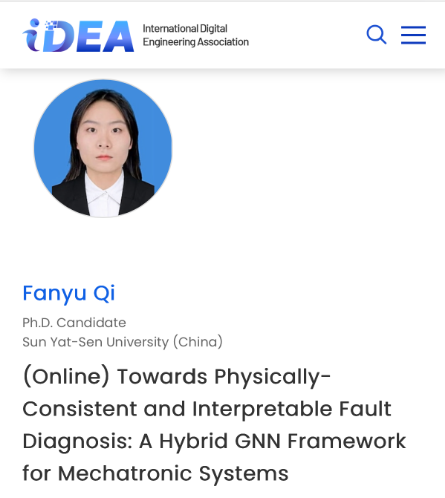
Recently, the AI Cube Laboratory at Sun Yat-sen University’s School of Advanced Manufacturing achieved new progress in international academic exchange. Laboratory PhD student Qi Fanyu participated in the 5th International Conference on Digital Twins (DigiTwin 2025), held from October 14 to 18, 2025 (German local time).
The 5th International Conference on Digital Twins (DigiTwin 2025) is one of the important international academic conferences in the field of digital twins and smart manufacturing, aiming to bring together global scholars, researchers, and industry experts to explore the latest advances and future trends in digital twin technology. This conference invited 7 internationally renowned experts including Professor Dieter Budde from the University of the Federal Armed Forces Munich and Professor Thomas Lukasiewicz from the University of Oxford to deliver keynote presentations, and set up 22 thematic sub-forums covering 210 presentation sessions.
In the “Digital Experiment, Testing and Verification (ETV)” sub-forum of this conference, PhD student Qi Fanyu delivered an academic presentation titled “Towards Physically-Consistent and Interpretable Fault Diagnosis: A Hybrid GNN Framework for Mechatronic Systems.”
The presentation addresses challenges in fault diagnosis of complex mechatronic systems, including strong nonlinearity, multi-component coupling, and difficulties in accurately modeling physical mechanisms, proposing a solution that integrates physical knowledge with data-driven approaches. This research aims to address the pain points where traditional physical models struggle to characterize complex behaviors while purely data-driven methods (such as deep learning) generally lack interpretability and generalization capabilities. The hybrid Graph Neural Network (GNN) framework proposed by Qi Fanyu integrates physically-consistent constraints into deep learning models, enhancing both diagnostic accuracy and model interpretability, providing new research directions for the field of industrial intelligent fault diagnosis, and engaging in exchanges with participating scholars after the presentation.
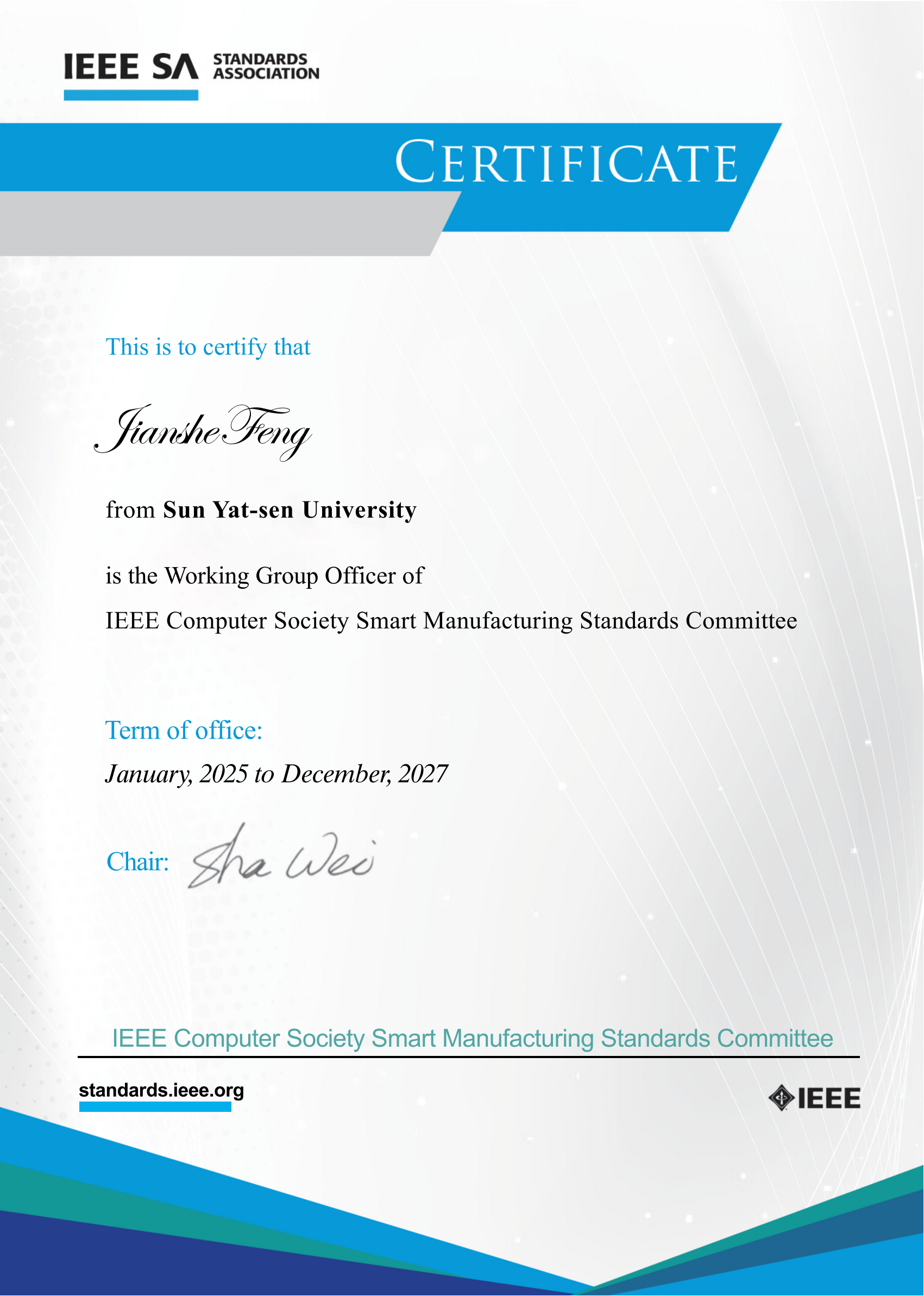
PhD student Qi Fanyu’s academic presentation at this international conference demonstrates the AI Cube Laboratory’s research progress and cutting-edge exploration capabilities in industrial artificial intelligence, particularly in intelligent fault diagnosis, predictive maintenance, and digital twins. The advancement of this work owes much to the careful guidance of laboratory head Associate Professor Feng Jianshe and benefits from the laboratory’s long-term academic atmosphere of “balancing research and engineering, integrating theory and application.”
The laboratory congratulates Qi Fanyu on his academic progress and looks forward to him achieving more fruitful research results in his PhD stage. The AI Cube Laboratory will continue to focus on cutting-edge technologies in industrial intelligence and digital twins, adhering to high standards and international training models, and contributing more innovative strength to promoting smart manufacturing and intelligent upgrading of high-end equipment in China!