

Physics-Informed Hypergraph Networks for Compound Fault Diagnosis and Traceability
Mapping physical topology into hypergraph priors, combined with a physics-informed multi-task network and uncertainty-driven cascaded inference, achieves 99.55% compound-fault diagnosis accuracy

Project Overview
High-order dynamic coupling in complex electromechanical systems makes features hard to disentangle; flat diagnostic pipelines lack mechanistic and cascaded reasoning, and black-box inference offers no risk measure. This project proposes a protocol that maps physical topology into hypergraph priors, explicitly representing high-order physical coupling across multiple components.
Research Objectives
Mapping bond graphs into high-order physical hypergraph priors
A multi-task diagnostic network regularized for physical consistency
An uncertainty-driven cascaded inference strategy
Methodology
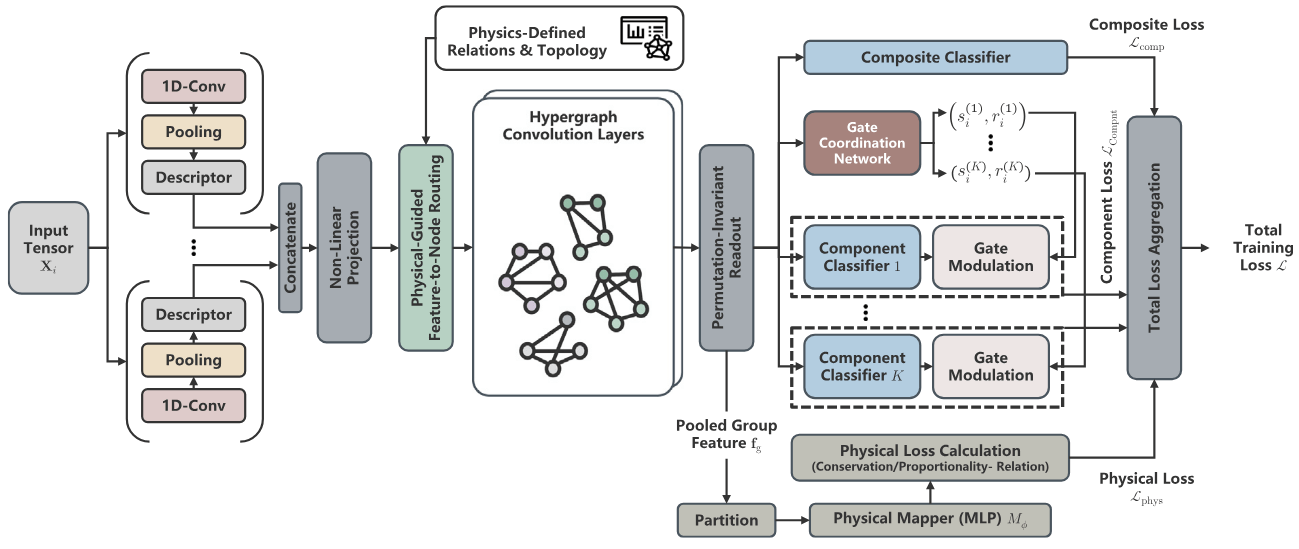
A physics-informed hypergraph multi-task network aggregates interaction features under physical-consistency regularization; sample-level uncertainty dynamically governs diagnostic depth, balancing accuracy against inference efficiency.
Technical Approach: How It Works
- 1
Physical Topology to Hypergraph Prior
A protocol maps "bond graphs to high-order physical hypergraphs": the energy-flow topology of the electromechanical system is explicitly translated into a hypergraph structure, where a single hyperedge represents one group of multi-component coupling relations.
- 2
Physics-Informed Hypergraph Multi-Task Network
Message passing over the hypergraph aggregates interaction features, with physical-consistency regularization keeping the learned representation aligned with the system's physical state; multi-task heads output component-level and system-level diagnoses simultaneously.
- 3
Uncertainty Quantification
Each diagnostic output carries an uncertainty estimate quantifying "how confident the model is," providing a risk measure for safety-critical decisions.
- 4
Uncertainty-Driven Cascaded Inference
Easy samples take a lightweight fast path; only high-uncertainty samples are routed to deeper, fine-grained diagnosis — balancing accuracy and inference efficiency at a routing rate below 50%.
Figures: Methods & Results
Key Results
Compound-fault diagnosis accuracy of 99.55%
Cascaded strategy achieves selective inference at a routing rate below 50%
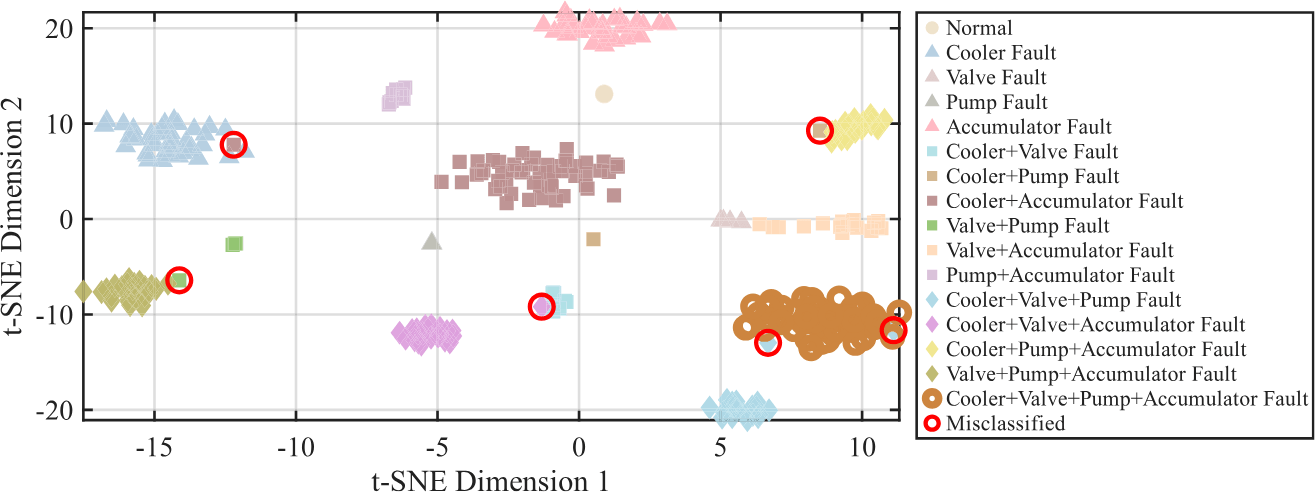
Feature manifolds align closely with physical states, precisely isolating high-uncertainty samples
Related Publications
Uncertainty-informed cascaded diagnosis of compound faults in electromechanical systems via a physics-informed hypergraph framework, Reliability Engineering & System Safety, 2026
Online Equipment Fault Diagnosis