

Precision Remaining-Useful-Life Prediction for High-End Equipment (PHM 2025 World Champion)
An operating-condition-aligned, risk-aware remaining-useful-life prediction framework that won first place worldwide, by a clear margin, at the PHM 2025 international data-challenge

Project Overview
Remaining-useful-life prediction for aero engines is central to predictive maintenance: constantly shifting operating conditions and nonlinear degradation near end-of-life make accurate modeling difficult, and existing methods neither explicitly exploit operating conditions nor focus on the end-of-life regime.
Research Objectives
Explicit modeling and feature enhancement conditioned on operating state
Prioritizing end-of-life prediction accuracy while suppressing overestimation
Robust prediction under few-shot, structurally complex time-series data
Methodology
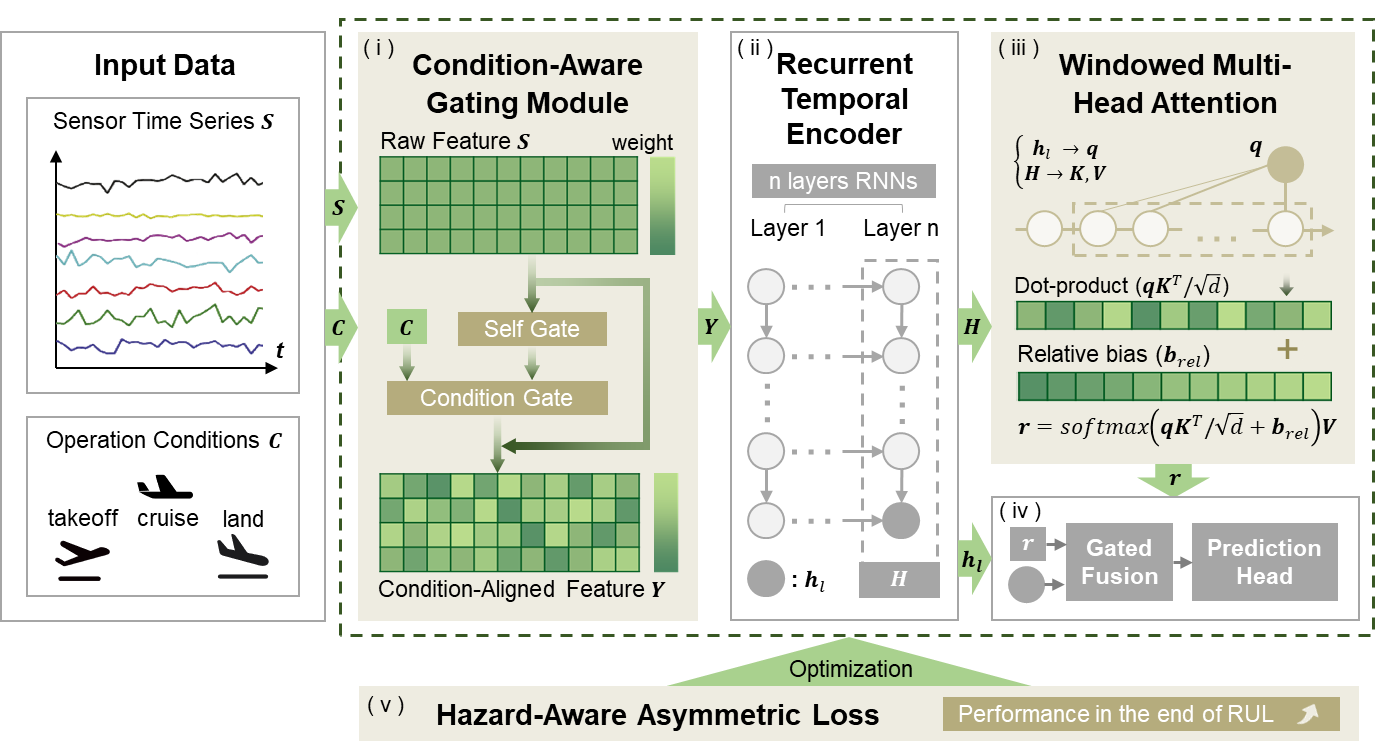
Operating conditions act as a gating mechanism applied directly to sensor data for feature alignment and enhancement; a risk-aware loss function is designed so the model attends more closely to the end-of-life regime while avoiding life overestimation.
Technical Approach: How It Works
- 1
Operating-Condition Alignment Module
Operating conditions are fed as input to a gating mechanism that acts explicitly on multi-sensor time series, aligning before enhancing — removing the interference of varying conditions on degradation features (rather than concatenating conditions as an ordinary feature).
- 2
Recurrent Time-Series Network + Locally Enhanced Attention
The aligned features feed into a recurrent time-series network paired with locally enhanced attention that captures key local patterns in the end-of-life regime.
- 3
Risk-Aware Asymmetric Loss
A hazard-aware asymmetric loss penalizes "overestimating remaining life" more heavily, making the model more conservative and precise near end-of-life — since the cost of a prediction error is inherently asymmetric.
- 4
Two-Stage Few-Shot Framework
Common degradation representations are first learned on structurally complex, full-scale time series, then fine-tuned for the few-shot target aircraft model — winning first place worldwide at the PHM 2025 data challenge.
Figures: Methods & Results

Key Results
Ranked first worldwide at the PHM 2025 international data-challenge, with a clear lead in prediction accuracy
The first Chinese university team to win the championship, drawing wide coverage across Sun Yat-sen University's media outlets
Related Publications
A Two-Stage Framework for Small-Sample RUL Prediction on Structurally Complex Time-Series Data, Annual Conference of the PHM Society, 2025
Online Equipment Fault Diagnosis