

Physics-Informed AI for Online Monitoring and Diagnosis of Precision Forming
In precision forming, batch anomalies are often invisible until final inspection — by which time entire lots have already been scrapped. This project writes forming mechanics into the algorithm: each production cycle signal is segmented according to the actual die motion phases, probabilistic priors tell the model which segments to watch, and a detector trained on normal parts only learns the boundary of "normal," classifying every part as pass, anomaly, or review-needed within the production takt time. Validated on two real production lines, the method achieves 99.32% and 94.92% accuracy under zero anomaly-sample training.

Project Overview
In precision forming, certain batch anomalies show up as nothing more than a brief amplitude change in the process signal — too faint for manual sampling to catch, and by the time final inspection flags it, batch-level returns are already inevitable. Instead of sorting parts after the fact, this project makes the call during the forming process itself: the signal is segmented along the die’s actual motion sequence so the algorithm looks for evidence only where physics says trouble should appear. Taking stamping and injection molding lines as examples, the approach has been validated and deployed.
Research Objectives
Translate forming-process mechanics into computable signal segments and features
Inject process expertise into feature selection via probabilistic priors
Establish normal boundaries and decision thresholds without anomaly samples
Make anomaly scores traceable to specific process steps for root-cause analysis
Methodology
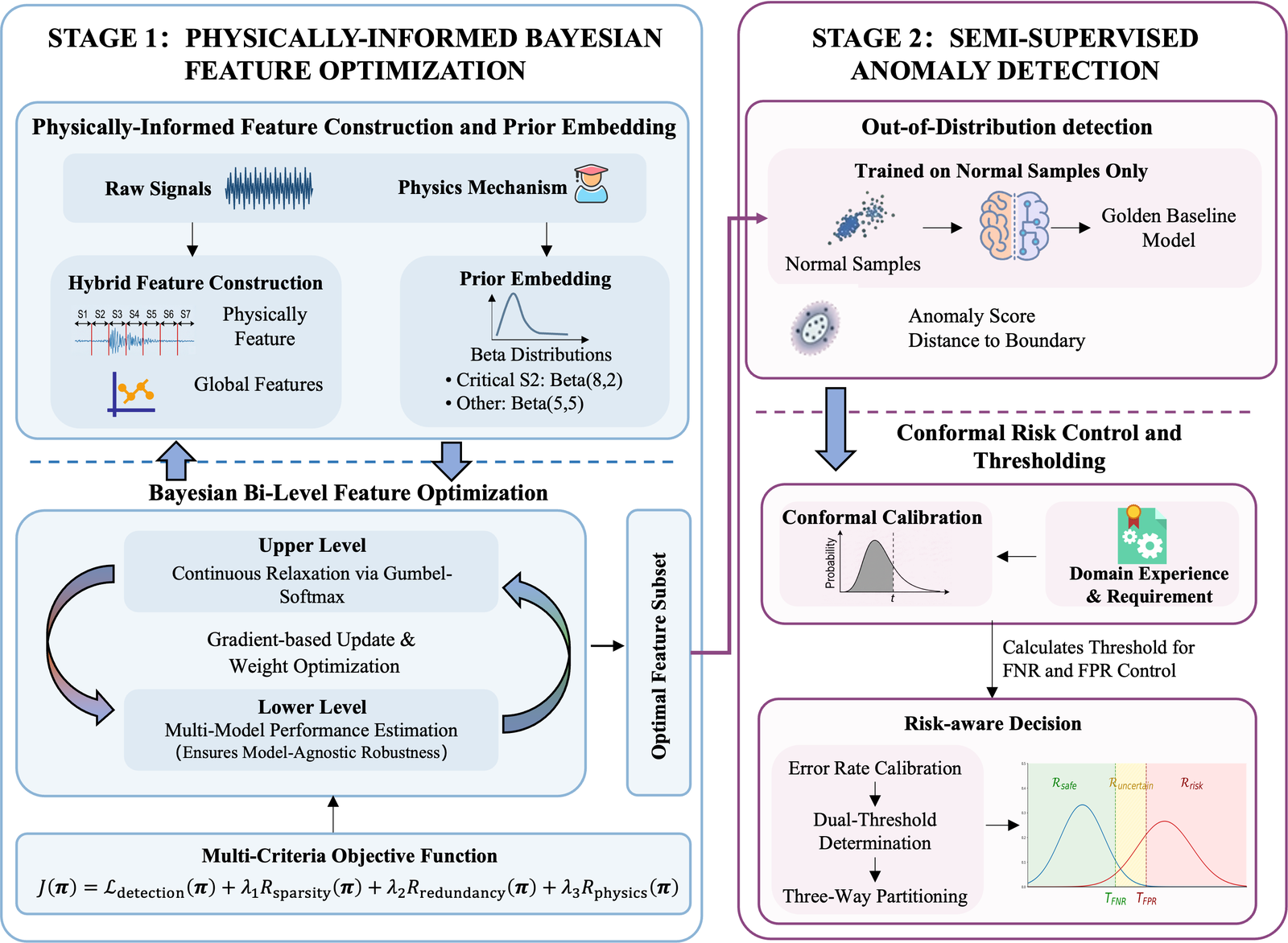
Forming mechanics split each cycle’s signal into several phases; time- and frequency-domain statistics per phase, combined with global principal components, form the candidate feature pool. Probabilistic priors encode process knowledge for each feature, and continuous relaxation drives a differentiable search balancing discriminability, sparsity, and physical consistency. The detection stage trains an out-of-distribution model on normal parts only, with conformal calibration setting dual thresholds.
Technical Approach: How It Works
- 1
Segment Signals by Die Motion Phases
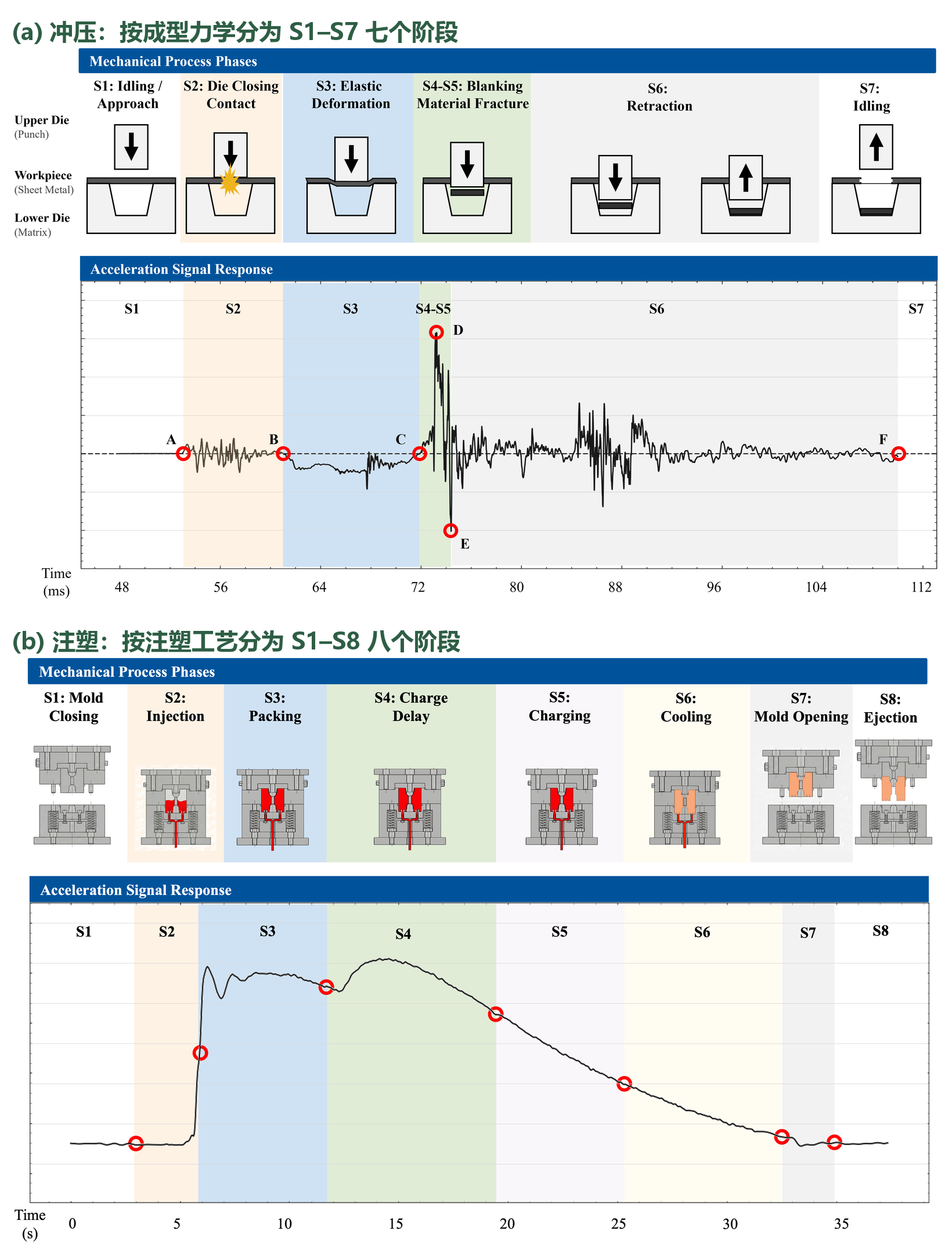
Averaging over the full signal washes out localized anomalies, so the signal is first segmented by forming mechanics. Following the actual motion sequence of the die — clamping, pressurizing, forming, holding, and retraction — each cycle is split into several phases, and time- and frequency-domain statistics are extracted independently from each phase. Different forming processes have different phase structures, but the segment-and-extract approach is universal.
- 2
Encode Process Knowledge as Probabilistic Priors
Experienced operators know which phase is most likely to go wrong, but that intuition is opaque to an algorithm. The solution assigns a probabilistic prior to every candidate feature: high-risk phases receive high prior weight, low-risk phases get low weight, and uncertain phases are left at a neutral value for the data to decide. The priors steer feature selection toward physically meaningful segments from the start, rather than relying on statistics alone.
- 3
Train on Normal Parts Only
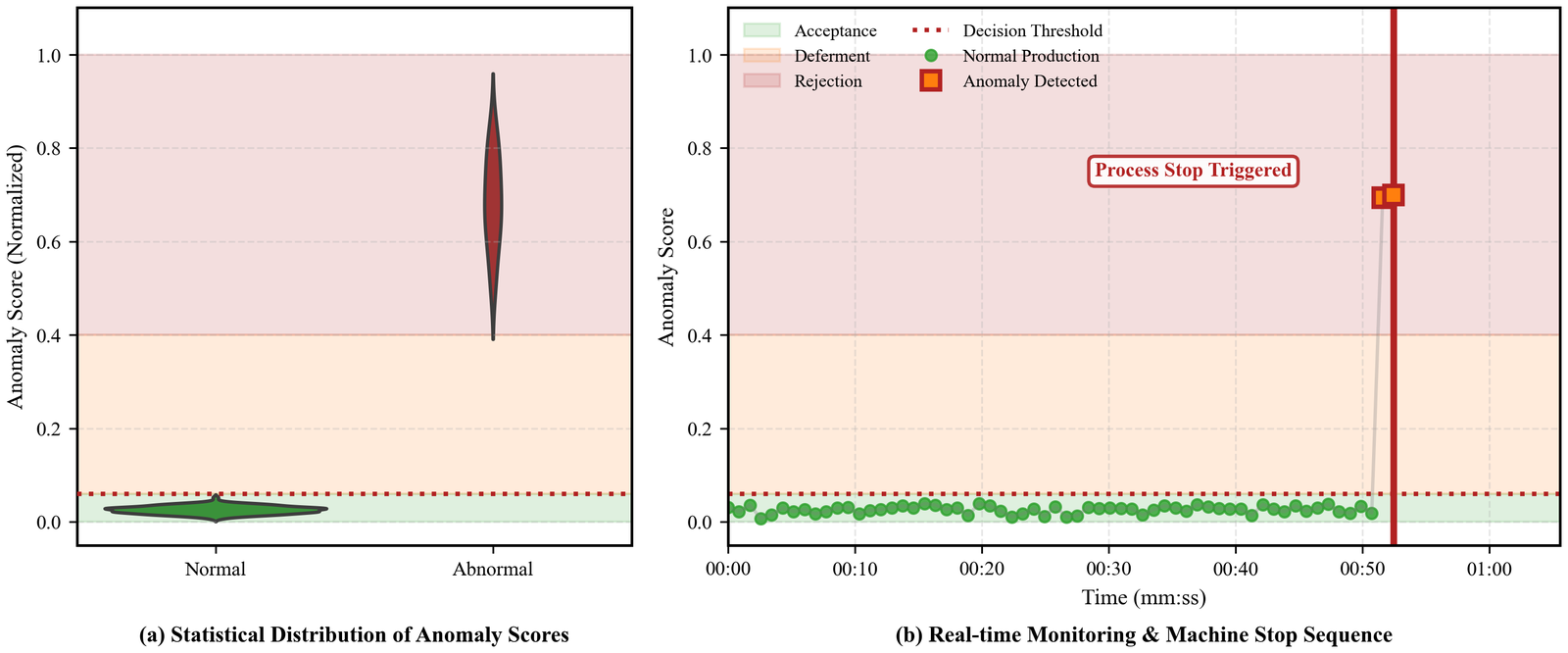
High-yield lines produce few defective parts—not enough to learn a reliable decision boundary. The detection stage takes the opposite approach: an out-of-distribution (OOD) model is trained on normal samples only, learning a boundary that encloses the normal region, with the anomaly score defined as the distance to that boundary. Conformal calibration then constrains both the miss rate and the false-alarm rate, yielding two thresholds that sort parts into pass, anomaly, and review-needed.
- 4
Trace Anomaly Scores to Process Steps
The anomaly score is not a black-box output: feature-selection results and interpretability analysis jointly show that selected key features concentrate in the phases where mechanical change is most intense, and anomalous samples exhibit deviation patterns consistent with the underlying process mechanics. The higher the score, the larger the deviation, letting engineers pinpoint the offending process step directly.
Figures: Methods & Results
Key Results
99.32% accuracy under zero anomaly-sample training, with a 5.00% miss rate below the best baseline
Injection-molding line validation: 94.92% accuracy, F1 of 0.907
Field deployment: anomalies as small as 0.02 mm detectable; batch anomaly rate down 97.35%; outgoing defect rate reduced by 78%
Related Publications
Physically-Informed Bayesian Feature Optimization for Semi-Supervised Industrial Anomaly Detection, Measurement Science and Technology, 2026
Profile Abstract: An Optimization-Based Subset Selection and Summarization Method for Profile Data Mining, IEEE Transactions on Industrial Informatics, 2023
Intelligent Monitoring of Manufacturing Processes