

Multi-Agent Automation for Full-Pipeline Precision Motor Testing
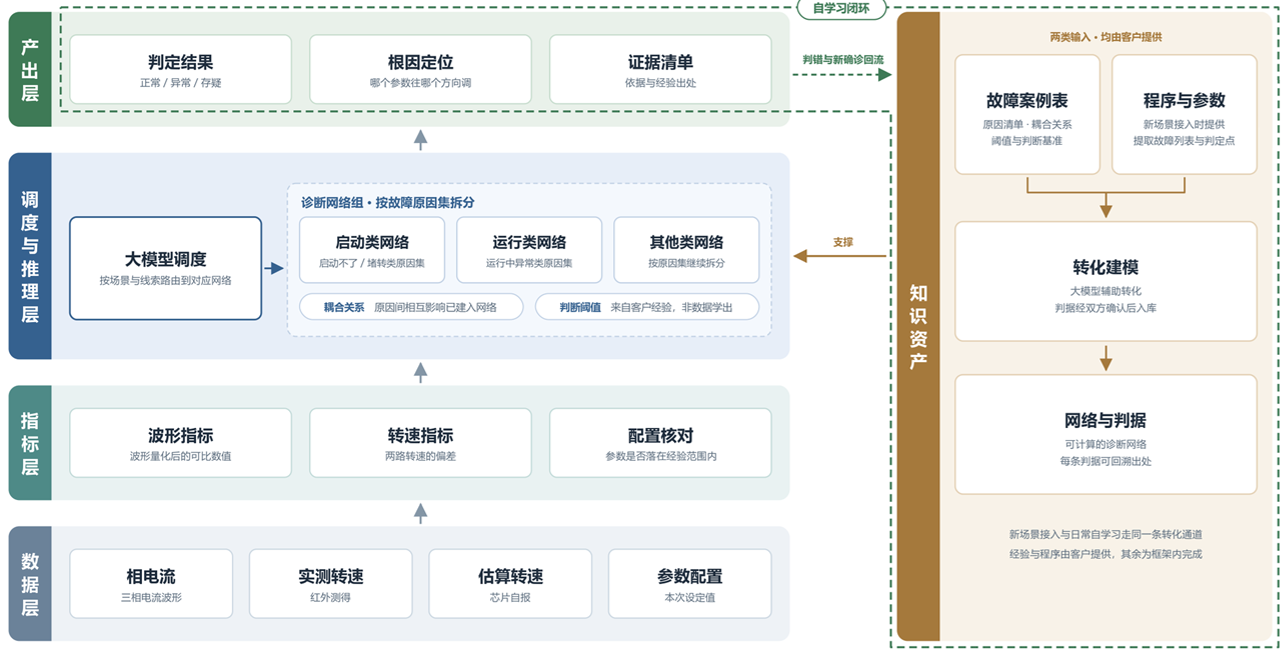
Pass/fail judgment for precision motors has long relied on engineers eyeballing waveforms and calling on experience — the same curve may yield a different verdict from a different person, and the reasoning is hard to trace back. This project rebuilds that manual judgment into a four-layer automated pipeline: test data are first converted into comparable quantitative indicators, then a Large Language Model (LLM) routes the evidence to the relevant Bayesian Diagnostic Network by scenario, and the system outputs a verdict, root cause, and an evidence manifest. Network structures and judgment thresholds come from on-site expert experience, confirmed item by item before entering the knowledge base; misjudged and newly diagnosed cases feed back to update the criteria, so the system sharpens with use. The method has been validated in development testing on a cooling-fan startup fault diagnosis scenario.
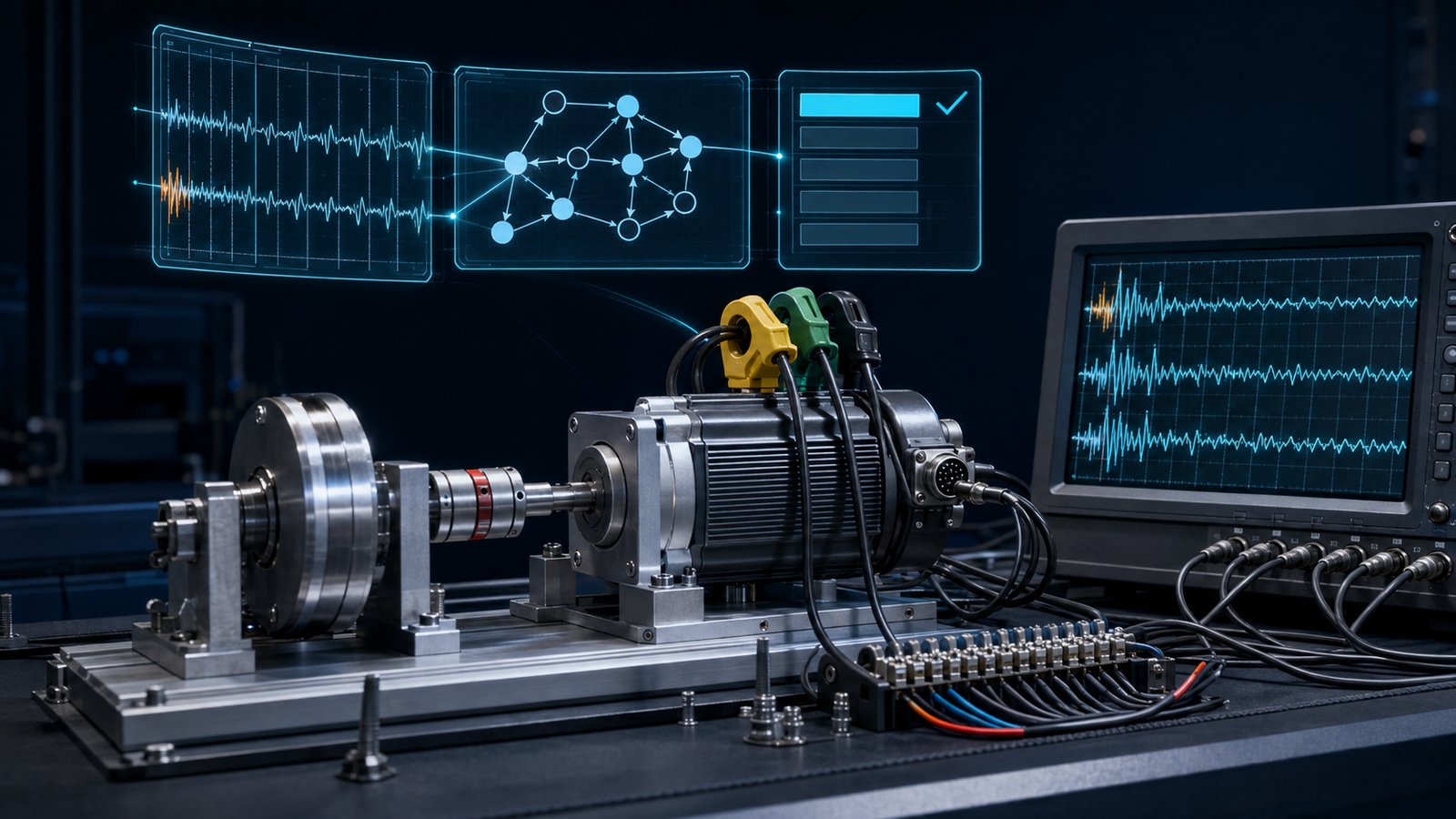
Project Overview
Pass/fail judgment in precision motor test-and-tuning has long depended on individual expertise: an engineer glances at a phase-current waveform and a speed trace, then calls it — standards drift across personnel and shifts, and conclusions are hard to trace back to specific evidence. This project rebuilds that manual workflow into an automated, explainable, and auditable diagnostic pipeline — test data are processed layer by layer into quantitative indicators, an LLM dispatches specialized diagnostic networks by scenario, and every conclusion is accompanied by the measurement evidence and expert-knowledge provenance it rests on. Cooling-fan startup fault diagnosis is the first deployed scenario for this approach.
Research Objectives
Automated conversion of multi-channel test data into comparable quantitative indicators
Encoding on-site expert experience into computable diagnostic networks and criteria
LLM-orchestrated scenario-aware dispatch to specialized diagnostic networks
Automated delivery of verdicts, root-cause localization, and evidence manifests
Methodology
Starting from three-phase current waveforms, infrared-measured actual speed, chip-estimated speed, and the current parameter configuration, the pipeline first computes waveform indicators and two-path speed deviations and checks whether parameters fall within experience-defined ranges; an LLM then routes each test — by scenario and indicator clues — to the appropriate Bayesian Diagnostic Network from a set organized by fault-cause family (startup, runtime, etc.). Cause-coupling relationships and judgment thresholds inside each network derive from on-site experience rather than data fitting, and every criterion is confirmed item by item before entering the knowledge base, with traceable provenance recorded.
Technical Approach: How It Works
- 1
Turn Waveforms into Comparable Numbers
Inputs are three-phase current waveforms, infrared-measured actual speed, chip-reported estimated speed, and the parameter setpoints for this test run. The first layer makes no judgment — it folds continuous waveforms into comparable quantitative indicators: waveform-derived numerics, the deviation between the two speed paths, and whether parameters lie within experience-defined ranges. Information contracts and conclusions sharpen at each successive layer, grounded in a shared measurement basis.
- 2
The LLM Dispatches the Right Network
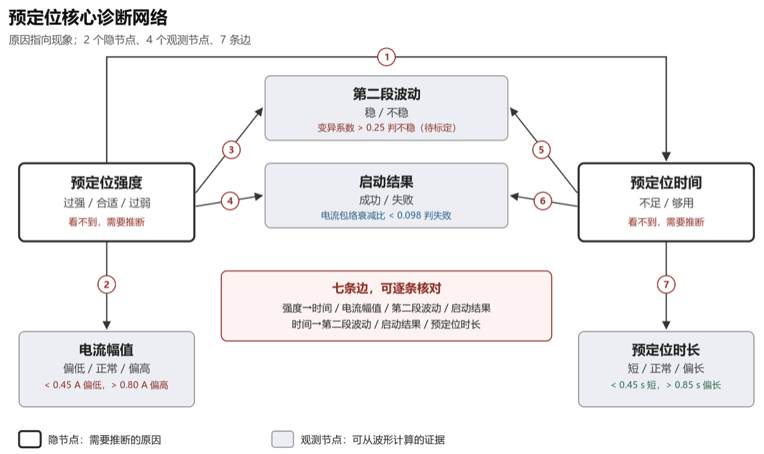
Diagnosis does not rely on a single all-purpose network. Fault causes are grouped — startup, runtime, and so on — each served by its own Bayesian Diagnostic Network that can be added or removed independently. The LLM reads the current scenario and indicator clues, then routes the test to the matching network, invoking only the relevant criteria. Cause-coupling relationships are already encoded in the network; parameter center values are taken from program standard values, and tolerance bands are derived from repeated validation runs under the same operating condition.
- 3
Every Conclusion Comes with Its Evidence
The output is not a bare pass or fail but a three-part package: a verdict of normal, abnormal, or inconclusive; a root cause pointing to a specific parameter and the direction of adjustment; and an evidence manifest listing, item by item, the measurement evidence behind the conclusion, the corresponding expert criterion, and the case that criterion originates from. Where evidence is insufficient, the system marks the case inconclusive, states the gap, and does not force a verdict.
- 4
Misjudged Cases Circle Back to Refine Criteria
On-site misjudgments and newly diagnosed faults not yet in the knowledge base flow back to the knowledge-asset side. The LLM restructures scattered tuning logs into standardized case entries, then translates them into updated criteria and network revisions. Every update takes effect only after confirmation by both parties — unconfirmed items are not committed; which criterion changed, based on which case, confirmed by whom, and effective from when are all on the audit trail. The updated network takes effect in the next test cycle, closing the loop.
Figures: Methods & Results
Key Results
Motor test-and-tuning pass/fail accuracy of 99.8% with a 73% efficiency gain over manual judgment (field deployment)
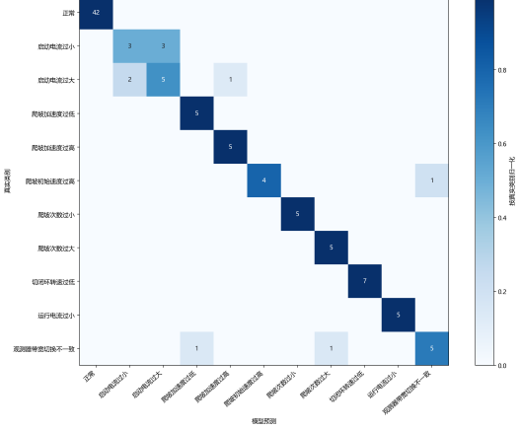
Startup-phase leave-one-out validation accuracy of 91.0%, with zero false rejects of normal units (development validation)
Macro-averaged F1 of 92.88% for four-class pre-positioning judgment, with every conclusion traceable to specific measurement evidence and expert provenance (development validation)
Diagnostic networks are modular by fault-cause family, individually maintainable; misjudged cases feed back and update criteria only after mutual confirmation, with full audit trail
Real-Time Optimization of Production Operations