

One Foundation Model for Monitoring, Diagnosis, and Virtual Metrology
Anomaly detection, fault diagnosis, and virtual metrology on the shop floor are typically three separate models, each retrained from scratch whenever equipment or processes change. The team built an industrial time-series foundation model: self-supervised pre-training on unlabeled signals first teaches a shared backbone the general dynamics of time series; the backbone is then frozen and each downstream task attaches only a lightweight head, fine-tuned with minimal labeled data. Validated on real stamping and injection-molding lines, the single backbone delivers an anomaly-detection F1 of 97.0% with zero false alarms, a fault-diagnosis Macro-F1 of 94.6%, and a virtual-metrology RMSE of 0.0259 mm — all outperforming individually trained baselines.

Project Overview
On any production line, anomaly detection, fault diagnosis, and virtual metrology are usually three independent systems — three sets of labels, three rounds of feature engineering, three models — and everything starts over when the equipment changes. This project reverses the sequence: a shared backbone network first learns universal time-series patterns from large volumes of unlabeled signals; each downstream task then plugs in a lightweight module and goes live after minutes of fine-tuning on a small labeled dataset. Data from real stamping and injection-molding lines confirm the approach works.
Research Objectives
Support anomaly detection, fault diagnosis, and virtual metrology with a single shared backbone
Freeze the backbone and train only a small set of task-specific parameters
Bring new tasks online in minutes with minimal labeled data, no full retraining
Make attention weights align with actual process stages so that decisions are traceable
Methodology
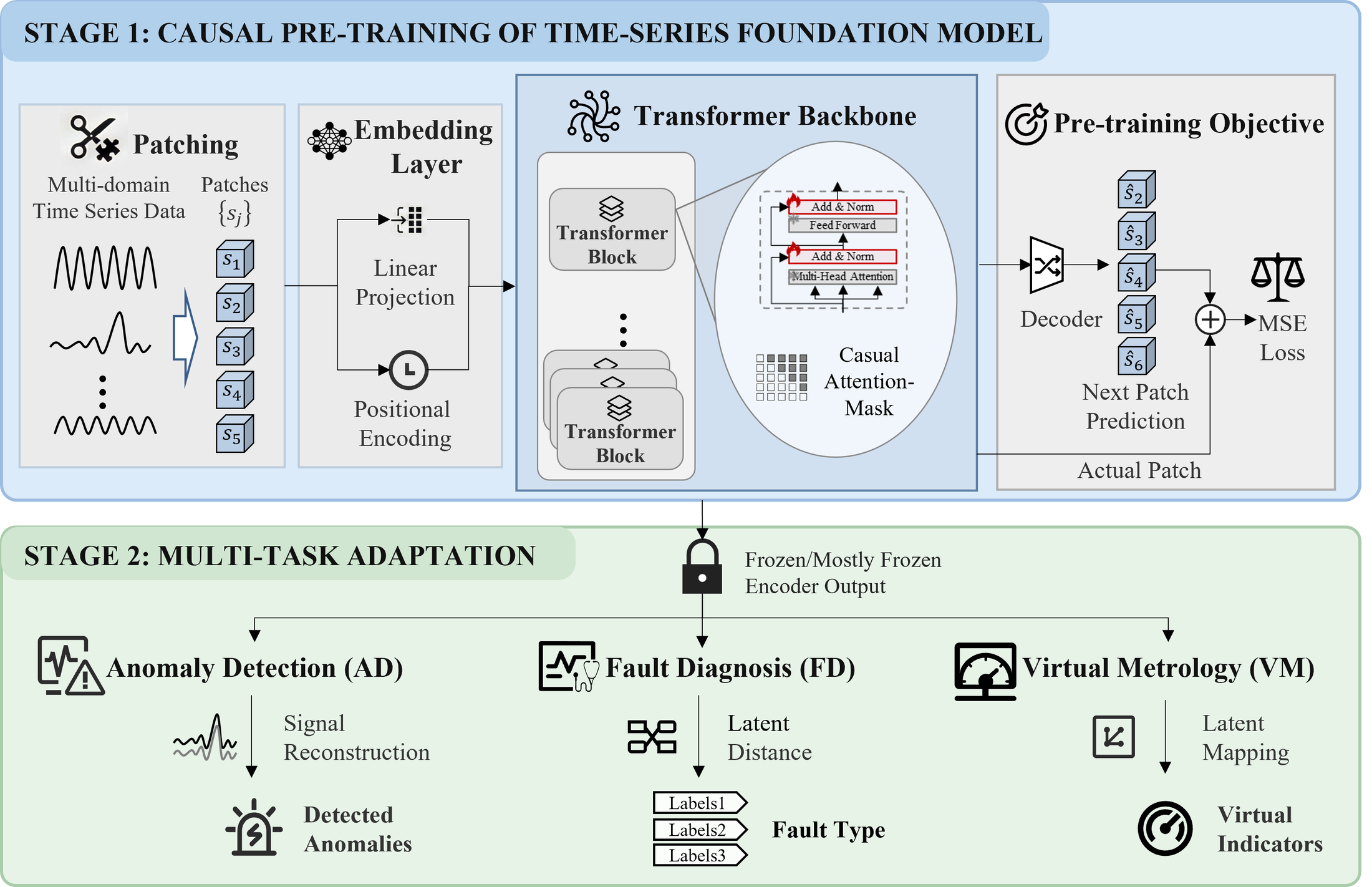
Multi-channel sensor signals are segmented into fixed-length patches, each treated as a token for a Transformer backbone. Stage one performs causal next-patch-prediction pre-training — label-free, covering both general-domain and manufacturing time series. Stage two freezes the backbone and attaches a lightweight head per task, each requiring only minutes of fine-tuning to go live.
Technical Approach: How It Works
- 1
Teach the Model to Read Signals Before Talking Tasks
Pre-training mixes public time-series corpora together with manufacturing-process signals. The objective is to predict the next signal patch from the preceding context — no labels required. Industrial sites are starved of labels, yet this step turns massive unlabeled archives into training fuel.
- 2
Freeze the Backbone, Attach One Small Head per Task
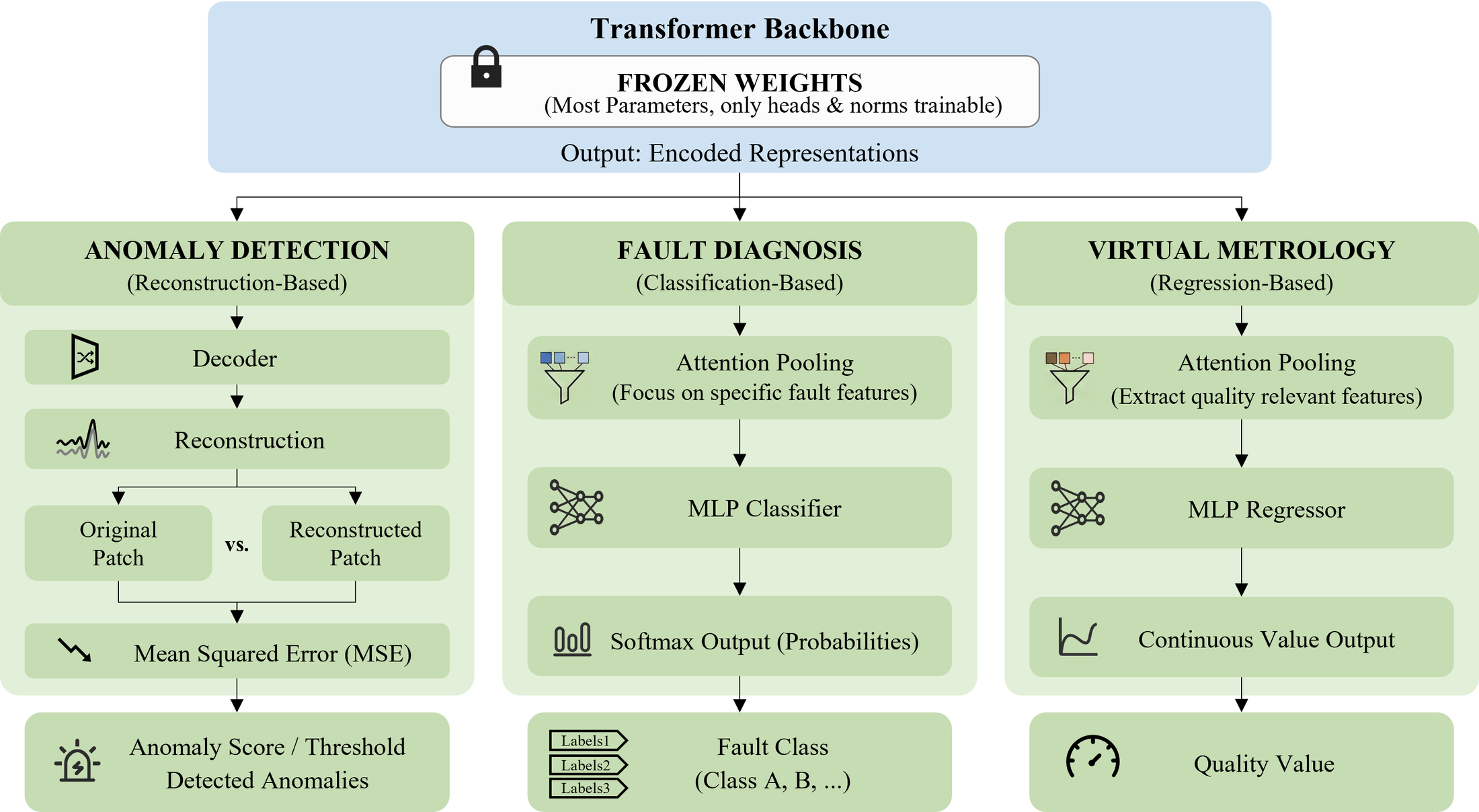
During fine-tuning the backbone weights stay fixed; only a task-specific lightweight module is trained. The trainable parameter count is orders of magnitude below full per-task fine-tuning, curbing overfitting on small samples and preserving the knowledge learned during pre-training.
- 3
Three Tasks, Three Readers, One Shared Representation
The same backbone output is read differently by three heads. Anomaly detection reconstructs waveforms through a decoder and flags cycles whose reconstruction error exceeds a threshold set on normal training samples. Fault diagnosis uses attention pooling to weight and aggregate patches before classification. Virtual metrology aggregates likewise, then feeds a regression head to predict hard-to-measure quality indicators.
- 4
Attention Lands on the Process Stages That Actually Matter
The model's attention weights map directly onto stamping process stages: slug-induced defects concentrate on the clamping and elastic-deformation stages, misfeed activates only the clamping stage, and mispunch falls on the tearing stage. Occlusion experiments confirm the alignment — masking the highest-attention patches sharply drops diagnostic accuracy, while masking random or lowest-attention patches leaves it almost unchanged.
Figures: Methods & Results
Key Results
Anomaly-detection F1 of 97.0% with zero false positives
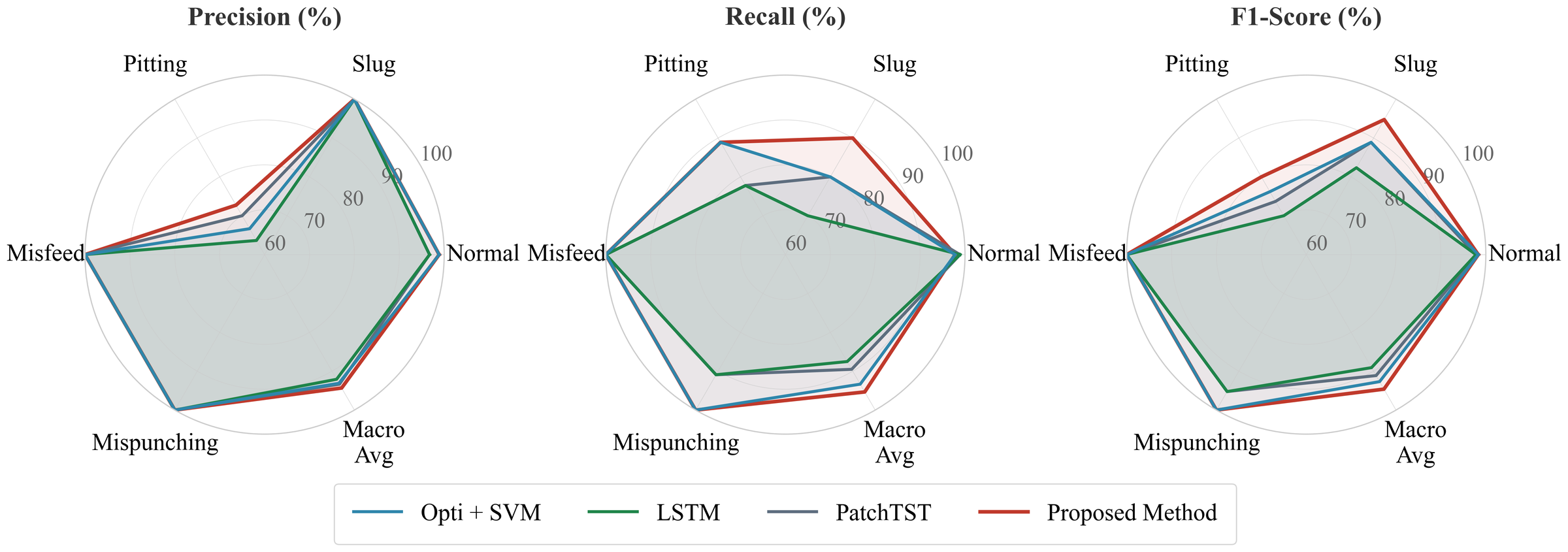
Five-class fault diagnosis at Macro-F1 94.6%, surpassing the best baseline
Virtual metrology RMSE of 0.0259 mm with R² 0.868
The research direction has produced 4 SCI papers and 3 granted invention patents to date
Related Publications
Towards Manufacturing General Intelligence: A Unified Multi-Task Time Series Foundation Model for Integrated Industrial Process Monitoring, under review, 2026
Intelligent Monitoring of Manufacturing Processes