

Intelligent State Sensing and Risk Assessment for Injection-Molding Production
On a busy injection-molding floor, dozens of machines run simultaneously while molds, materials, and recipes change several times a day — fixed-threshold alarms either miss real faults or cry wolf constantly. The team builds a per-condition baseline for every machine automatically, scores each molding cycle with a detection model trained on normal samples only, and ranks the most suspicious process parameters when an alarm fires so engineers can head straight for the root cause. The system has been productized with a leading smart-manufacturing technology enterprise, and the methods have been validated on real injection-molding data.

Project Overview
The biggest headache on an injection-molding floor is not a broken machine — it is a machine that looks fine while parts quietly develop sink marks or short shots, noticed only when a batch has already been scrapped. This project ingests in-mold pressure, temperature, coolant temperature, and flow-rate signals, analyzes them phase by phase along the molding cycle, maintains an automatic baseline per operating condition, and scores and localizes anomalies in real time — shifting quality control from post-hoc sampling to in-process detection.
Research Objectives
Segment process signals by the physical phases of the molding cycle and extract key features
Automatic condition recognition with self-building, self-updating baselines
Online anomaly detection and tiered alerting using normal samples only
Root-cause localization and virtual metrology of critical dimensions
Methodology
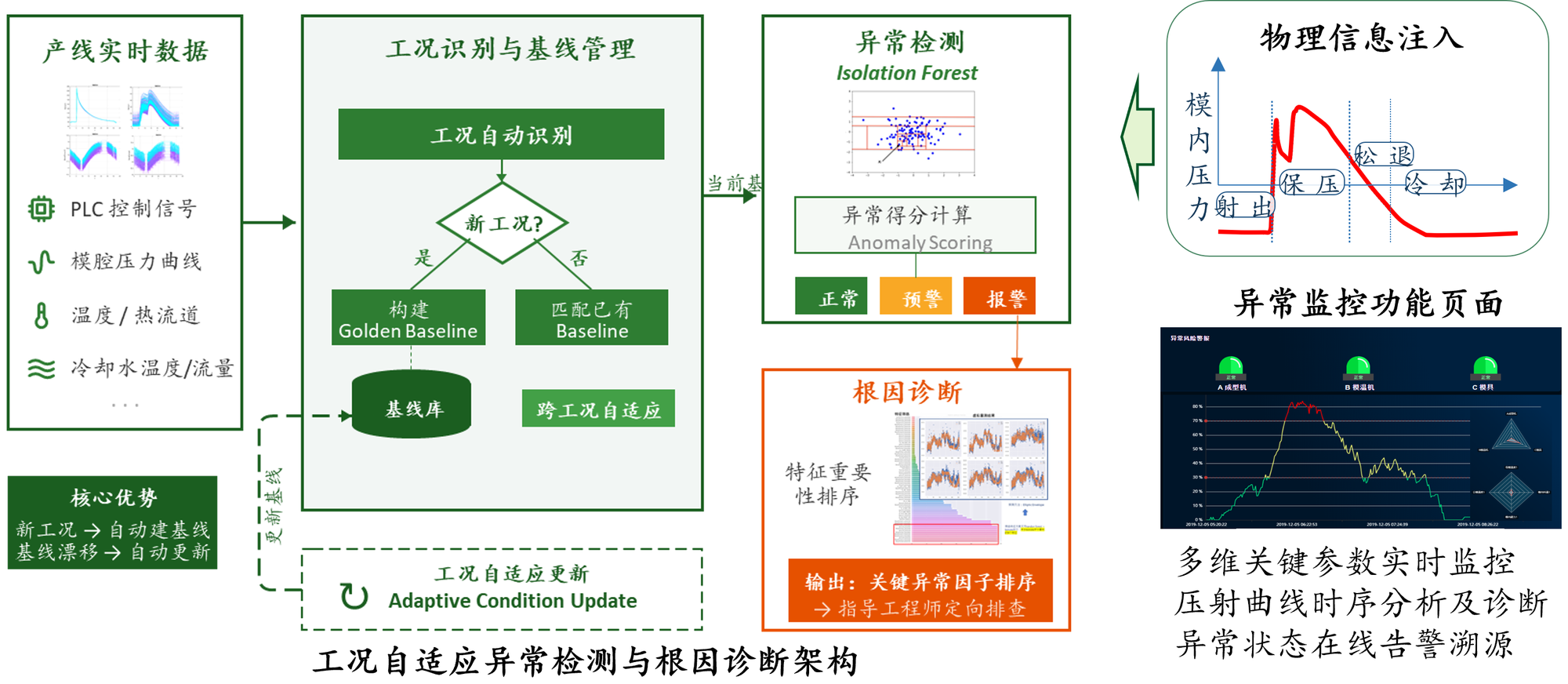
Physical-phase segmentation of the molding cycle anchors Bayesian feature optimization that distills key indicators from redundant signals; a condition-recognition module identifies the current recipe and matches or creates baselines; a detection model trained on normal samples only with conformal-calibrated thresholds outputs anomaly scores and three-tier alerts, followed by feature-importance ranking for root-cause guidance.
Technical Approach: How It Works
- 1
Split Signals by Molding Phase
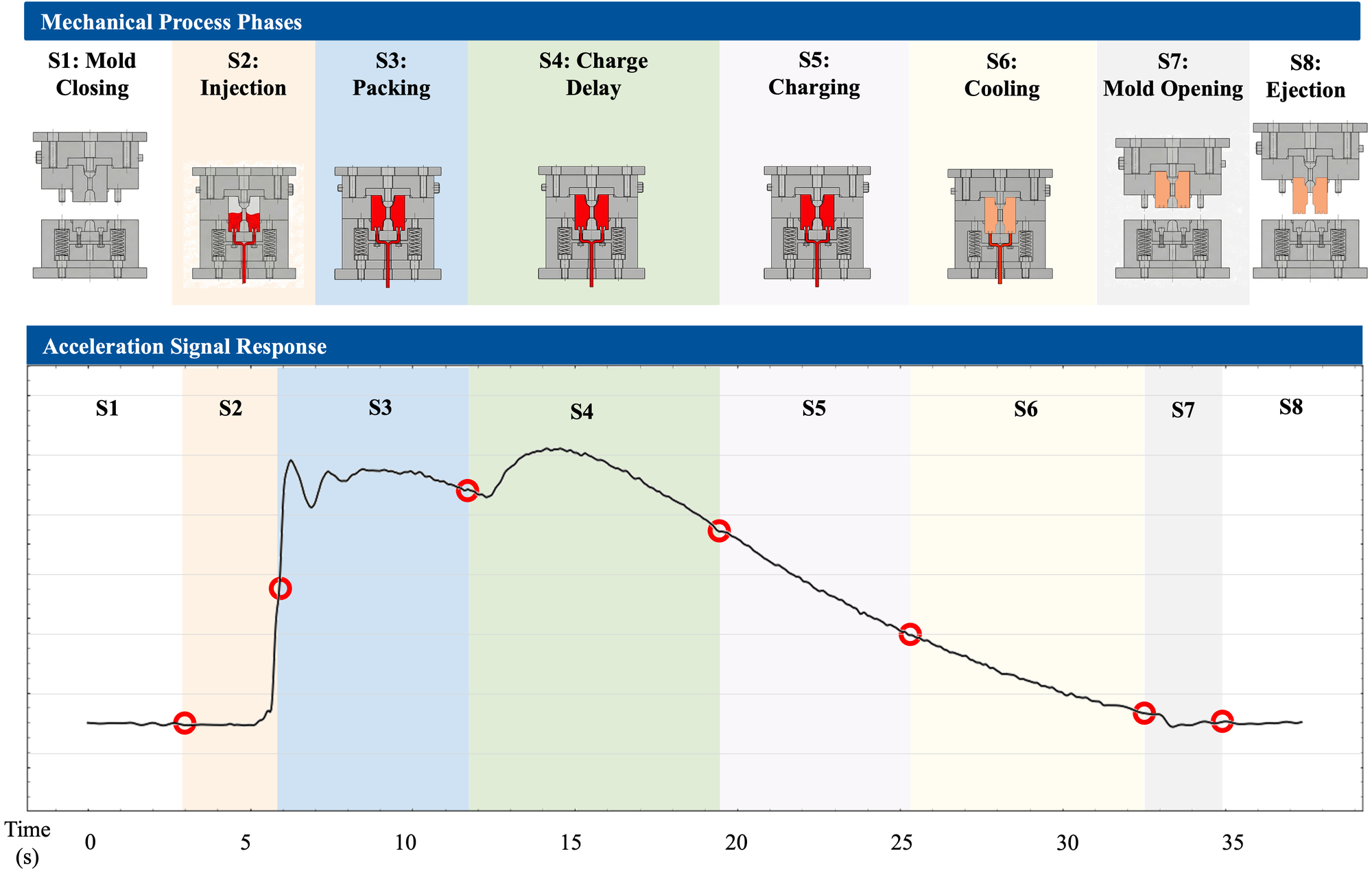
A single injection cycle spans multiple physical phases, each governed by different mechanics and producing different anomaly signatures. The system segments the in-mold pressure curve phase by phase and extracts statistical features per segment. After selection, the key features concentrate in the packing and charge-delay phases — exactly where sink marks and short shots surface first.
- 2
Auto-Build a Baseline per Condition
Every mold, material, or recipe change reshapes the signal profile, rendering fixed thresholds useless. The system detects the current operating condition automatically: a new condition triggers construction of a golden baseline stored in the baseline library; a known condition is matched to its existing baseline, which drifts-adapts as the equipment ages. Engineers never retune alarm parameters for a new product.
- 3
Detect Anomalies Without Fault Samples
Faults on a running line are rare — collecting enough labeled samples can take half a year. The detection model trains on normal samples only, using out-of-distribution methods such as Isolation Forest to compute an anomaly score for each cycle, then sorts cycles into normal, warning, and alarm tiers.
- 4
Point Engineers to Where to Look
A bare "anomaly" verdict leaves engineers guessing. Alongside every alarm the system outputs a ranked list of contributing factors — whether packing-phase pressure dropped or coolant temperature drifted — narrowing the search from dozens of parameters down to two or three.
Figures: Methods & Results
Key Results
Productized with a leading smart-manufacturing technology enterprise, supporting per-machine alerting and line-level risk monitoring across multiple injection machines
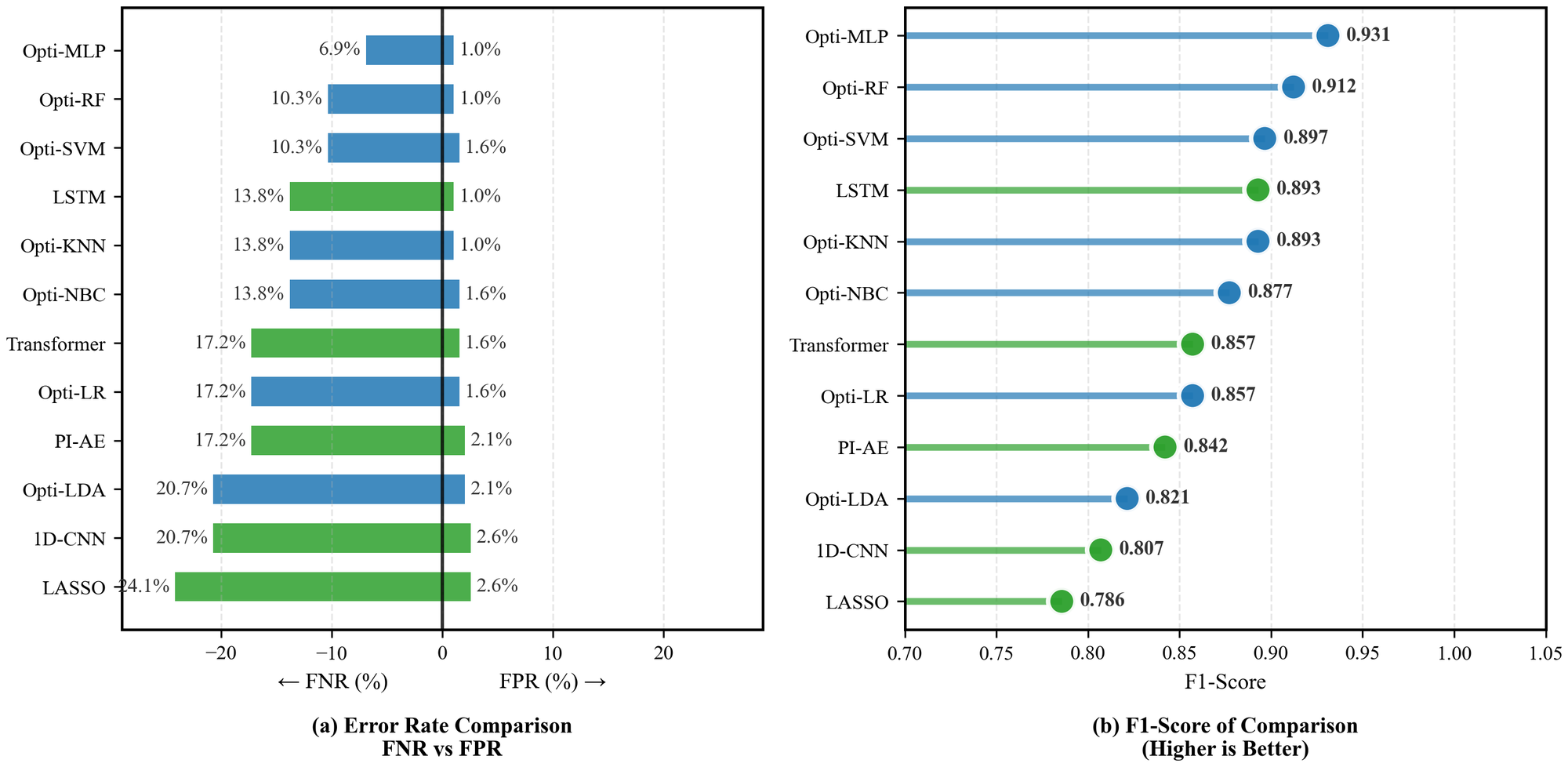
Method validation: 94.92% accuracy, F1 of 0.907, and 3.88% false-alarm rate — trained without any anomaly labels
Virtual metrology of critical dimensions achieves RMSE of 0.0259 mm
Case featured in the books Industrial Big Data and Industrial AI
Related Publications
Physically-Informed Bayesian Feature Optimization for Semi-Supervised Industrial Anomaly Detection, Measurement Science and Technology, 2026
Towards Manufacturing General Intelligence: A Unified Multi-Task Time Series Foundation Model for Integrated Industrial Process Monitoring, Under Review, 2026
Real-Time Optimization of Production Operations